
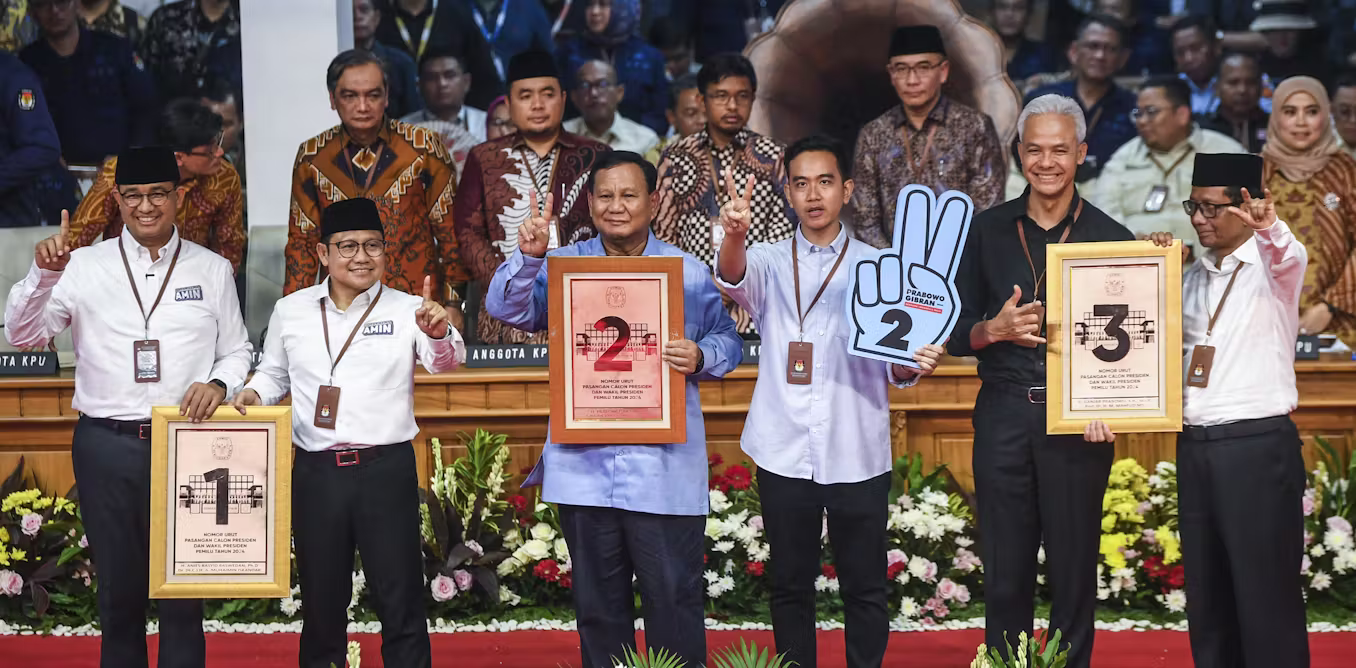
The 2024 Presidential Election is a crucial moment for Indonesia. Presidential candidates bear great responsibility, including addressing environmental damage and ensuring energy sustainability. One issue that has attracted attention is the commitment to renewable energy. In this regard, we will question the commitment of Prabowo Subianto and Gibran Rakabuming Raka towards the renewable energy sector if they are elected as president and vice president. Will their promises truly be fulfilled or are they just political rhetoric?
The presidential and vice-presidential pair, Prabowo-Gibran, placed the energy issue in their second mission. Their vision is to strengthen the national defense and security system and encourage national independence through self-sufficiency in food, energy, water, creative economy, green economy, and blue economy. Prabowo even instructed the Defense University to create Indonesia’s first study program on hydrology and water science. However, will this commitment be realized?
Prabowo Subianto, as one of the presidential candidates, has conveyed several of his views on renewable energy. However, we need to understand in more depth what he actually promised:
- Reducing dependence on fossil energy while making Indonesia the world’s green energy king (superpower) in the field of new and renewable energy (renewables) and vegetable raw material-based energy (bioenergy).
- Restoring national oil and gas and mining governance in accordance with the mandate of the Constitution, especially Article 33 of the 1945 Constitution.
- Improving the incentive scheme to encourage the discovery of new energy reserve sources to increase national energy security and sovereignty.
- Revising all inhibiting regulations to increase new investment in the new and renewable energy (NRE) sector.
- Establishing crude oil refineries, ethanol factories, as well as gas receiving terminal infrastructure and gas transmission/distribution networks, by both State-Owned Enterprises (BUMN) or the private sector.
- Expanding the conversion of fuel oil (BBM) to gas and electricity for motor vehicles. Increasing and adding the portion of new and renewable energy in PLN’s electricity mix.
- Continuing and evaluating the development of specialized special economic zones by prioritizing the green economy and/or blue economy.
If we summarize, there are at least three main points in the Prabowo-Gibran promises for renewable energy that will be implemented if they are elected as President and Vice President of the Republic of Indonesia for 2024–2029:
- Biofuel and Agriculture: Prabowo spoke about increasing the use of biofuels from vegetable raw materials such as palm oil, corn, and sugarcane. However, according to the Director of the Center of Economic and Law Studies (Celios), Bhima Yudhistira, there must be integration of these policies so that they do not cancel each other out and confuse planning. Because, he said, the move would also confuse the planning of the industry, especially motor vehicle manufacturers, spare parts suppliers, and community workshops. Although Indonesia has already used biodiesel, bio-jet fuel, and bioethanol, the use of these fuels is still in the early stages. Additionally, biofuels are not yet price-competitive compared to fossil fuels.
- Energy Security: Prabowo emphasized the importance of self-sufficiency and security in the country. He argued that Indonesia must produce its own food and energy. Prabowo Subianto previously promised to stop the import of Fuel Oil (BBM) if elected in the 2024 Presidential Election. According to him, this effort would be carried out by boosting domestic energy self-sufficiency by producing BBM from biofuel raw materials. Prabowo stated that the need for diesel could later be met from palm oil. Furthermore, he claimed gasoline could be 100 percent derived from sugarcane.
- Continuing Jokowi’s Program: Prabowo is also committed to continuing the policies and programs that have been implemented by President Joko Widodo (Jokowi). Yet, we know that the Jokowi administration was massive in building coal-fired power plants (PLTU) amidst the oversupply of electricity on the islands of Java and Bali. Moreover, in the National Energy Council’s plan, Indonesia’s renewable energy mix target figure for 2025 was lowered from the original 23 percent to only 17–19 percent. How can this be aligned with the promise of realizing Indonesia as the world’s green energy king?
The commitment to renewable energy is hoped to be more than just rhetoric. Concrete steps and seriousness from the next government and related parties are needed. Here are a few things that need attention:
- Supportive Regulations: Prabowo must ensure regulations that support the development of renewable energy. This includes incentives for investment in this sector and policies that facilitate access to the latest technology.
- Investment in Research and Development: The development of renewable energy requires investment in research and development. Prabowo must ensure there is adequate budget allocation to explore Indonesia’s renewable energy potential.
- Collaboration with the Private Sector: The private sector has a key role in the development of renewable energy. Prabowo must build strong cooperation with the private sector to accelerate technology adoption and investment.
Prabowo’s commitment to renewable energy appears optimistic, but real challenges must be overcome. Supportive infrastructure development and regulations are key to success. Hopefully, the future leaders can ensure energy sustainability and a better environment for Indonesia.
Source:
