
Working together with residents under the scorching sun, Clean Energy Generation Volunteers installed a solar street light in Leuwi Hejo, Bogor Regency, West Java. (August 17, 2024, Gen-B Documentation)
Saturday, August 17, 2024, marks the 79th anniversary of the Republic of Indonesia’s independence. One of the greatest challenges facing Indonesia is ensuring a sufficient, affordable, and sustainable energy supply for all its people. Renewable energy has emerged as a future solution that is not only environmentally friendly but can also increase national energy independence. In the modern context, energy independence is a crucial pillar that can lead Indonesia to a brighter future. In the spirit of Independence Day, we need to reflect on Indonesia’s energy future. Renewable energy is not just about providing cleaner electricity, but also about realizing true independence: freedom from dependence on fossil fuels that produce alarming amounts of carbon emissions, freedom to live in an environment free from carbon emissions and all forms of waste that can pollute the environment, and freedom to leave a more beautiful and sustainable earth for future generations.
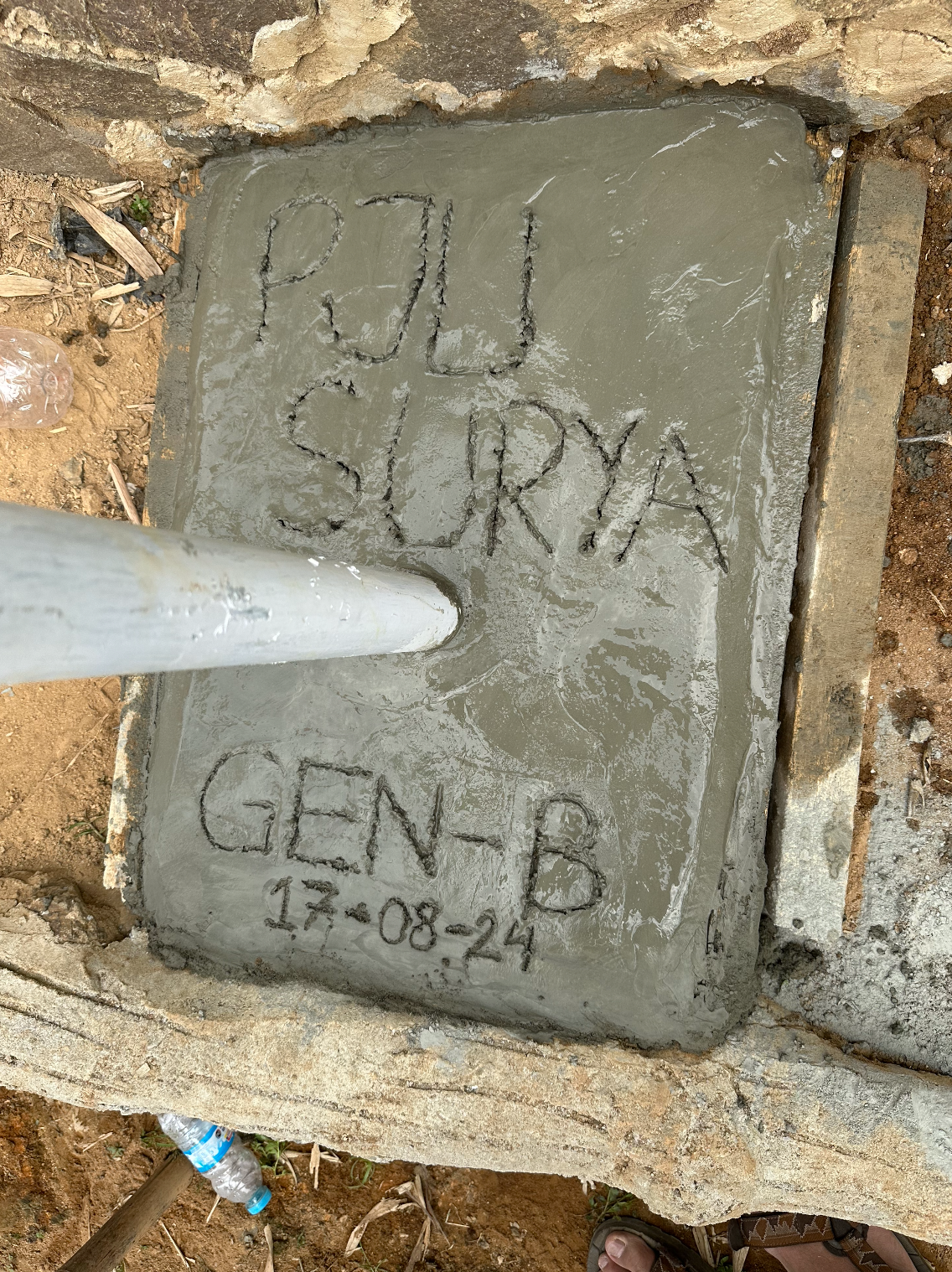
A marker under the foundation explains that Gen-B, together with local residents, has been working to achieve clean energy independence by installing solar street lights in Bogor Regency, West Java Province. (August 17, 2024, Gen-B Documentation)
Generasi Energi Bersih (Clean Energy Generation) is a community volunteer organization that aims to increase understanding and awareness of emission reduction and clean energy use in the community. We recognize the importance of clean energy access for all Indonesian citizens to support Indonesia’s Net Zero Emissions commitment by 2060 or sooner. However, remote areas with hilly access still lack electricity infrastructure, even though they are not too far from the center of government in Jakarta. Leuwi Hejo Village, located in Bogor Regency, West Java Province, is one of the villages geographically located at an altitude of 500 meters above sea level at the foot of the Sentul-Jonggol hills. This waterfall can be accessed via Jonggol, Citeureup, or Sentul. The origin of the name Leuwi Hejo is that “Leuwi” in Sundanese means “pool” or “pool,” while “hejo” means “green.” Despite having electricity from the National Electricity Company (PLN), several locations still lack adequate lighting. One example is the stairs leading up to the residents’ religious study house, located adjacent to the entrance to the Leuwi Hejo tourist attraction. This location is strategically located as it serves as a hub for community activities, including religious study sessions, and serves as an entry and exit point for all vehicles traveling to the Leuwi Hejo tourist area.
Gen-B Indonesia decided on the location of Leuwi Hejo based on the identified problem of insufficient lighting in this central hub of community activity. There were two options: installation at a location close to volunteers within Jakarta and the IESR office near Tebet Ecopark, or a more remote location, which presents a greater challenge in Bogor Regency. Considering the already adequate electricity network in Jakarta and the limited access to electricity in Bogor Regency, Gen-B decided to install solar-powered street lighting in Leuwi Hejo, Bogor Regency.
After the installation location was decided, the costs were calculated, including the installation of street lighting (PJU). The costs include poles, cement, batteries, and panel modules, as well as cable lines, panel supports, utilities, entrance fees, venue rental, and transportation of these materials to the Leuwi Hejo site. All costs are covered by JK International, a renewable energy company focused on increasing public awareness of emissions reductions and the adoption of renewable energy.
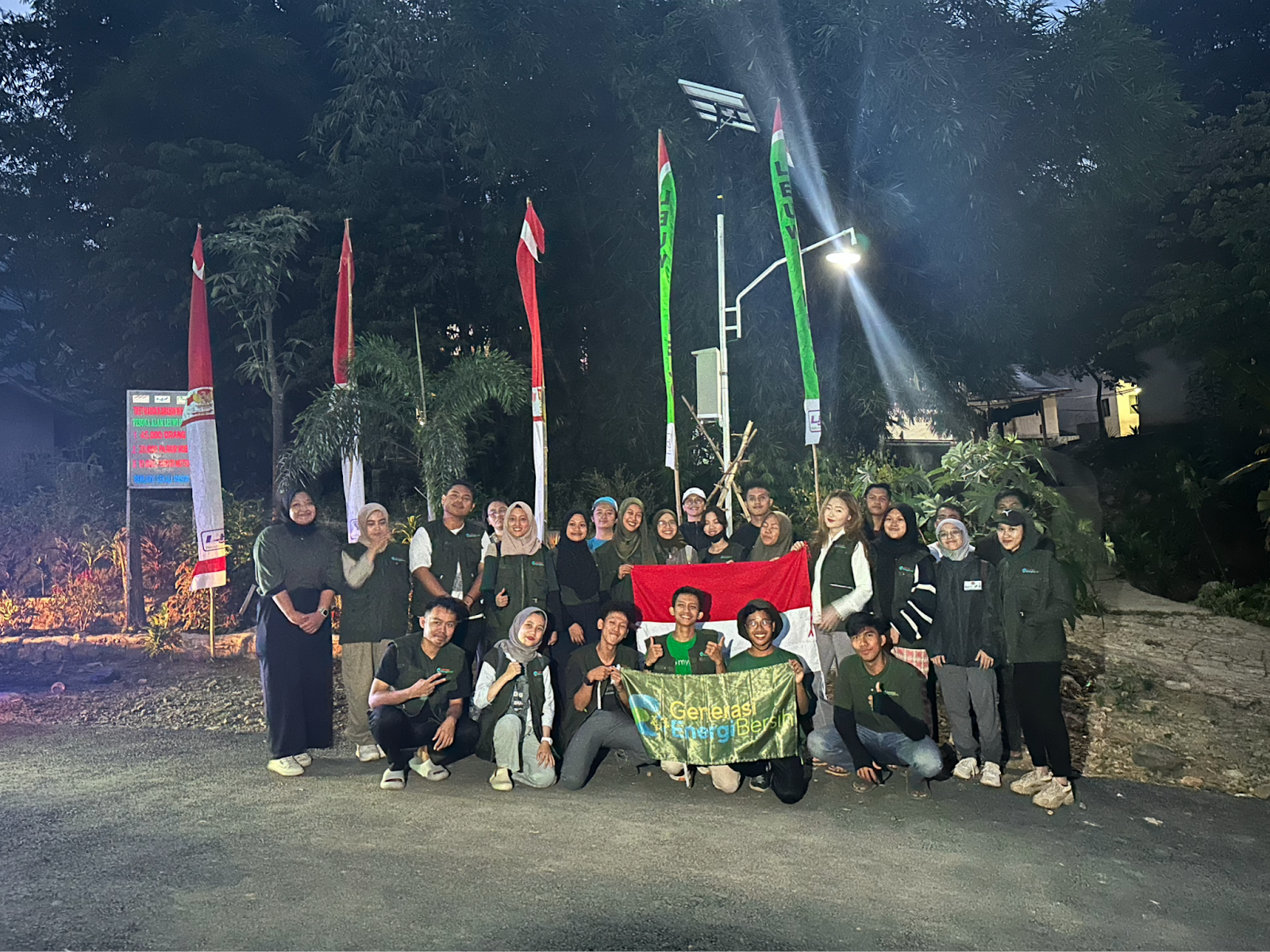
Together with residents and the management of the Leuwi Hejo Tourism Cooperative, Gen-B successfully installed solar-powered street lights (PJU) along the access route to the community’s religious study group and in front of the Leuwi Hejo Tourism Ticket Counter, Bogor Regency, West Java. (August 17, 2024, Gen-B Documentation)
Represented by the Cooperative Management, the community participated in the installation, learning how to properly care for and maintain the solar-powered street lights. They not only watched but also assisted with the installation process, such as drilling and installing the poles with cement. The residents’ enthusiasm for experiencing the benefits of renewable energy was palpable, evident in the friendly and cheerful expressions and the conversations between the Clean Energy Generation volunteers and the local residents.
“Thank God, we’ve installed a solar street light here, which has made things brighter. We can harness the sun’s heat from Allah SWT to generate electricity for residents to access the waterfall and to religious studies. I hope we can add another 10 solar street lights in the future,” said Utun Mahpud, Head of the Leuwi Hejo Tourism Cooperative, to the Gen-B Team.
The Clean Energy Generation volunteers were divided into four teams, each responsible for installing one solar street light component. The first team was responsible for installing the battery, the second team for the 4.5m pole component, the third team for the smart box component, and the fourth team for the solar panel module component. The installation process took approximately 2 hours and 30 minutes, starting at 10:30 a.m. and ending at 1:00 p.m. WIB.
The Gen-B Volunteer Team Leader has experience installing Solar Street Lighting in several areas in Indonesia, he also succeeded in designing several Solar Street Lighting components so that they can light 20 watt DC current lamps, “Actually, the maximum DC lamp can be up to 50 watts, but it must be ordered online, because it is very difficult to find DC current lamps in regular hardware stores. If it is not bright enough, residents can replace this 20 watt lamp with a brighter lamp, a maximum of 50 watts,” said Arkandhia Saputro, Head of the Indonesian Clean Energy Generation Solar Street Lighting Installation Team.
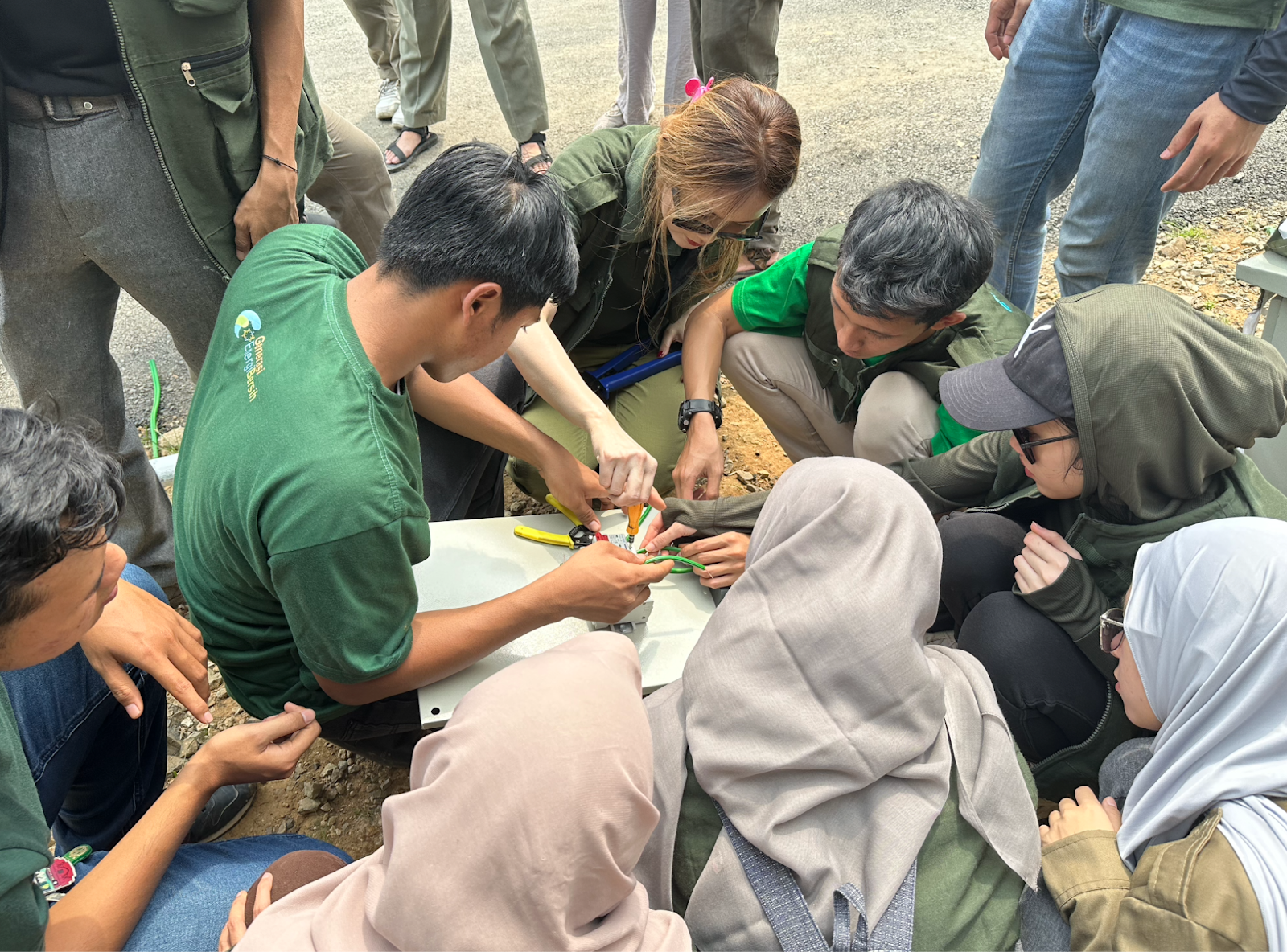
The process of cutting and installing the conductor cables to the Solar Street Light Smart Box was carried out by the National Chairperson of the Indonesian Clean Energy Generation, May Lynn, along with the Gen-B volunteer team. (August 17, 2024, Gen-B Documentation)
The Clean Energy Generation has a program of good practices for reducing emissions, including saving electricity through conscious energy consumption, encouraging people to use public transportation, and planting mangrove trees. The installation of this street light was designed quite differently. This initiative was executed by Rahmat Soleh, the Program Coordinator of Gen-B Indonesia. Rahmat and Arkan’s initiative aims to provide clean energy access to tourist locations that still need additional electricity access and provide learning facilities for the community to use clean energy. This initiative by the Indonesian Clean Energy Generation is not without its challenges. Undeveloped transportation access to the location, the considerable distance from Jakarta, and the substantial cost of building the Solar Street Light are some of the challenges Gen-B faces in achieving this Energy Freedom from Dirty Energy.
“Together with Gen-B, we are realizing Freedom from Dirty Energy! We must continue to support a just energy transition, and as much as possible, we help communities that have difficulty accessing clean energy. This solar street light can also be an educational instrument. We sincerely hope that with the installation of these public street lights, residents around Leuwi Hejo and visitors to the Leuwi Hejo Waterfall tourist attraction can have better access to lighting. Children no longer need to be afraid of falling when they want to recite the Quran because they will climb along the previously dark path, now it is lit. Hopefully, more and more people will be enthusiastic about joining the recitation and keeping watch at night around the tourist ticket post,” said May Lynn, Chair of the Indonesian Clean Energy Generation.
