
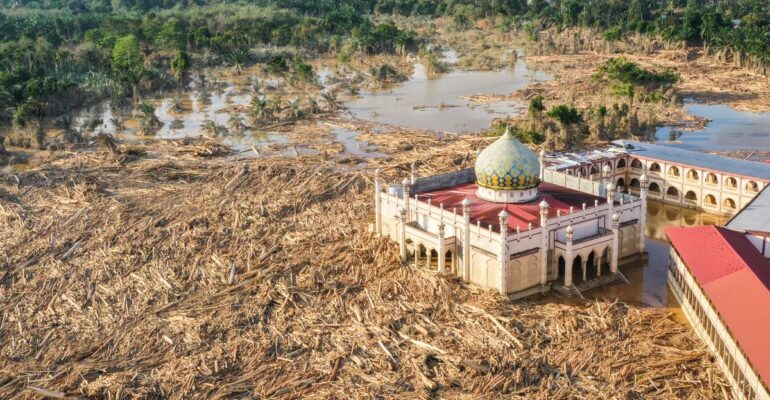
Sumatera is once again plagued by hydrometeorological disasters: floods, landslides, and extreme weather, which have become increasingly intense recently. We are witnessing news of a continuously rising death toll, washed-away homes, and paralyzed economic activity. Some people blame the weather, but this climatic phenomenon is exacerbated by the ecological crisis. Quoting an article in Harian Kompas on Thursday (December 4, 2025) titled Forest Conditions the Main Trigger for Disaster, Cyclone Senyar triggered the highest intensity rainfall in the history of observations in Indonesia.
Aceh, North Sumatera, and West Sumatera have suffered severe damage, with hundreds of fatalities and many residents still reported missing. However, the pattern of impact does not entirely align with the amount of rainfall. In several locations, areas that did not receive the most extreme rain experienced the heaviest damage. This confirms that the environmental capacity—ranging from forest conditions, land cover, to the stability of the watershed areas (DAS)—plays a more decisive role in shaping the level of disaster vulnerability than simply the amount of rain that falls.
There is a root problem that we must honestly acknowledge: environmental damage due to deforestation for exploitation continues to weaken nature’s carrying capacity, coupled with high greenhouse gas emissions from the industrial sector which further worsen the climate crisis. Data from the Ministry of Energy and Mineral Resources processed by the Mining Advocacy Network (JATAM) shows a worrying reality: Sumatera is filled with 1,907 active mining business permits (IUPs), covering an area of 2,458,469 hectares. Of this total, 217 permits are in South Sumatera, enough to make this province one of the largest mining epicenters in Indonesia.
Google Maps satellite imagery of the Merapi District, Lahat Regency, accessed on December 4, 2025, shows a drastically changed landscape pattern due to large-scale extractive activity. Areas marked with light brown color and irregular shapes indicate land that has been massively opened. This pattern is not only concentrated in one point but spreads out, forming a vast mosaic that breaks the continuity of the forest cover.
Green areas that should serve as ecological buffers appear fragmented, replaced by former mining pits, hauling roads, and overburden dumps. This fragmentation has the potential to disrupt local wildlife habitats, reduce biodiversity, and trigger changes in surface water flow patterns.
It is true that the coal sector has been the backbone of South Sumatera’s economy. In 2024, the economy of South Sumatera was still dominated by the Mining and Quarrying business sector at 24.69 percent (BPS South Sumatera, 2025). This abundant natural resource wealth presents the government with a dilemma: whether to continue boosting economic growth by sacrificing the environment, or to maintain environmental sustainability at the risk of losing a significant portion of the Local Own-Source Revenue (PAD). However, the economic contribution figures come with a series of social costs that are equally high. Based on a Cost-Benefit Analysis in the book Social Costs & Benefits of Coal Dirty Energy Exploitation (Subardin, Imam Asngari, Yuliusman; 2023), coal mining activities in the research location of Muara Enim were declared socially unfeasible in the long term, where the Marginal Social Cost (MSC) borne by the community was higher, exceeding the Marginal Social Benefit (MSB) received. This means that the community bears far more losses than the benefits received from mining activities. This burden includes a decline in water quality, including the cause of floods due to deforestation, followed by health damage, a decrease in agricultural productivity, and environmental degradation, the costs of which are never truly accounted for in economic reports.
Opening a New Perspective
In other words, we must seriously begin to consider alternatives to coal as an energy source. In addition to the pressure on the Ministry of Energy and Mineral Resources (ESDM) to implement a moratorium on mining business permits (IUPs)—followed by plans for the early retirement of Coal-Fired Power Plants (PLTUs)—efforts to form a supporting ecosystem on the downstream side must also be intensified. Taking this further, this change should not just stop at the policy or industry level. As end consumers, we also need to start opening ourselves to cleaner and more efficient energy options. As long as the public is comfortable with old patterns, the energy transition will continue to be held back.
This transition does not have to be achieved by drastically replacing energy sources all at once—and indeed, it is unrealistic if forced. But small, consistent steps need to start now. Consumers can start with the simplest things: choosing more electricity-efficient appliances, improving energy usage habits, or starting to consider clean energy options for some household needs. It doesn’t have to be installing solar panels on the entire roof immediately; just start with solar water heaters, energy-saving lamps, or participating in renewable energy-based services from local providers. On the other hand, PLN, as the electricity provider, must also be more aggressive in socializing these alternatives.
In line with this, South Sumatera is one of the provinces with the largest renewable energy potential in Indonesia. A study by the Institute for Essential Services Reform (IESR) shows that the technical potential for renewable energy in South Sumatera reaches 446,572 MW. However, out of this great potential, the installed capacity is only 989 MW (7.75 MW solar, 21.96 MW hydro, 813.41 MW bioenergy, and 146 MW geothermal). Compared to the technical potential version of the South Sumatera ESDM Office, which reaches 21,032 MW, this realization is only about 4.7%. This figure indicates that South Sumatera has an untapped “future reserve.”
“Not Just (an) Energy Transition”
On the other hand, the author also understands that the energy transition must not be conducted carelessly. It must proceed justly: (A) Just energy transition, not just (an) energy transition. Sonny Mumbunan and Sita Primadevi (2025) state that the energy transition must be planned by considering the synergy and trade-offs of each scenario, so that no region “falls” when coal is abandoned. In sustainability terminology, the principle of no one left behind is the intended middle ground to protect vulnerable groups in the transition process. In South Sumatera, this means we must also consider the fate of 101,045 workers (BPS Data 2025) who depend on the coal industry, along with the SMEs that live off the surrounding economic chain.
Interventions that can be carried out are providing skills training (upskilling & reskilling) and preparing a new horizon of thinking for the next generation, that there are many options they can pursue as professions in the future. In other words, the education of the younger generation must also be directed towards future opportunities—not only majors close to extractive and exploitative industries, but study paths that open the door to green jobs. According to the Green Workforce Development Roadmap by Bappenas, Indonesia has the potential for 56 million green jobs by 2025 and an increase to 72 million by 2029.
It is at this point that the role of the younger generation becomes crucial. If according to plan, Net Zero Emission (NZE) will only truly be achieved in 2060, when Generation Z (Born 1997-2012) will be at its peak. This means that we, the younger generation, must dare to enter a domain that aligns with Indonesia’s emission-free vision.
Generasi Energi Bersih (Gen-B), a community actively promoting new and renewable energy, believes that clean energy is not just a technology project, but a civilization project. Gen-B is present as a bridge between the community & government, and the business world to accelerate the adoption of clean energy in South Sumatera. We want to ensure that when South Sumatera moves toward future energy, everyone moves along, with no one left behind.
The series of ecological disasters we have faced recently should serve as a strong signal that the old approach to managing nature can no longer be maintained. Continuing to rely on a development model that erodes the environment will only magnify social and economic losses in the future. It is time we dare to make the more sensible choice: switching to clean energy as the foundation for a safer, fairer, and more sustainable future.
