
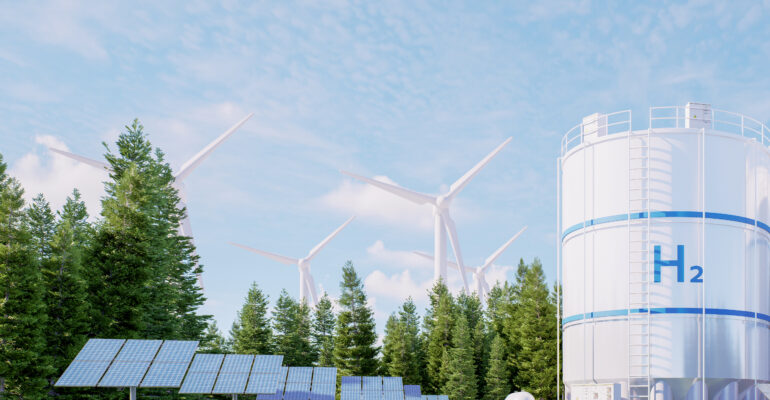
Clean hydrogen (low-emissions hydrogen) is increasingly occupying a central position in the global energy transition discourse. Global developments show significant acceleration on the supply side. Data from the Hydrogen Council notes that by 2025, committed global clean hydrogen capacity will reach over 6 million tons per year, while new demand currently stands at around 3.6 million tons per year.
Clean hydrogen refers to hydrogen produced with significantly lower greenhouse gas emission levels compared to conventional fossil-fuel-based hydrogen without carbon capture. Globally, this term refers to hydrogen produced through various technological pathways with low emission intensity throughout its life cycle. The emphasis is not on color classification, but on the magnitude of the carbon footprint generated from the production process to its utilization (International Energy Agency, 2024).
Clean hydrogen encompasses several major production pathways with different emission characteristics:
-
Blue Hydrogen: Produced from natural gas using Carbon Capture and Storage (CCS) technology to capture a portion of the resulting carbon emissions.
-
Pink Hydrogen: Generated through electrolysis using electricity from nuclear power plants.
-
Green Hydrogen: Produced through the electrolysis of water with electricity sourced entirely from renewable energy, such as solar and wind.
The Institute for Essential Services Reform (IESR) assesses that green hydrogen has the potential to become a strategic instrument for reducing greenhouse gas emissions, particularly in heavy industrial sectors and energy-intensive transportation. Through the electrolysis process, water molecules ($H_2O$) are decomposed into hydrogen ($H_2$) and oxygen ($O_2$) using an electric current. If that electricity comes from renewable sources, the entire production chain is near-zero emissions. This characteristic makes green hydrogen a relevant decarbonization solution for sectors that are difficult to electrify directly, such as steel, cement, fertilizer, and long-haul heavy transport.
Beyond contributing to climate change mitigation, green hydrogen holds strategic value in enhancing energy security. Producing green hydrogen based on local renewable energy—specifically wind and solar—allows countries to reduce dependence on fossil fuel imports. Therefore, green hydrogen plays a role not only in emission reduction but also in maintaining a more stable long-term energy supply.
The role of green hydrogen is also strengthening as the share of renewable energy in the global power system increases. According to IRENA’s $1.5^\circ\text{C}$ Scenario, by 2050, Variable Renewable Energy (VRE) will account for 70% of total global energy production, up from 9% today. In this context, green hydrogen serves as a complementary solution that plays a vital role in optimizing the utilization of ever-increasing renewable energy. Green hydrogen also plays a crucial role in replacing fossil-fuel-based hydrogen, which still dominates global production.
Projections from the International Renewable Energy Agency (IRENA) show that by 2050, green hydrogen could contribute about 14 percent of global final energy consumption. Achieving this contribution requires an installed electrolyzer capacity of more than 5,500 GW, with electricity demand reaching approximately 25,000 TWh. This figure is equivalent to the current total global electricity consumption, highlighting the massive energy system transformation required.
The success of green hydrogen as a decarbonization instrument is heavily influenced by a comprehensive development approach. Policy aspects, regulations, business models, and integration with the power system are just as important as technological readiness. The smart indirect electrification approach emphasizes operating electrolyzers flexibly to maintain grid stability, reduce peak loads, and mitigate system congestion risks.
Indonesia’s commitment to the development of clean hydrogen and ammonia has been outlined through the drafting of the National Hydrogen and Ammonia Strategy (SHAN) and the National Hydrogen and Ammonia Roadmap (RHAN). These documents map out renewable energy resource potential, domestic demand projections, and export opportunities for hydrogen and its derivatives as part of the national energy transition strategy.
Indonesia has also declared its support for green hydrogen development as part of its long-term decarbonization agenda and the strengthening of national industrial competitiveness. With significant potential in solar, wind, hydro, and geothermal energy, Indonesia aims to position itself as a hub for green hydrogen production and trade in the Asian region, while strengthening its position in the regional clean energy supply chain.
