
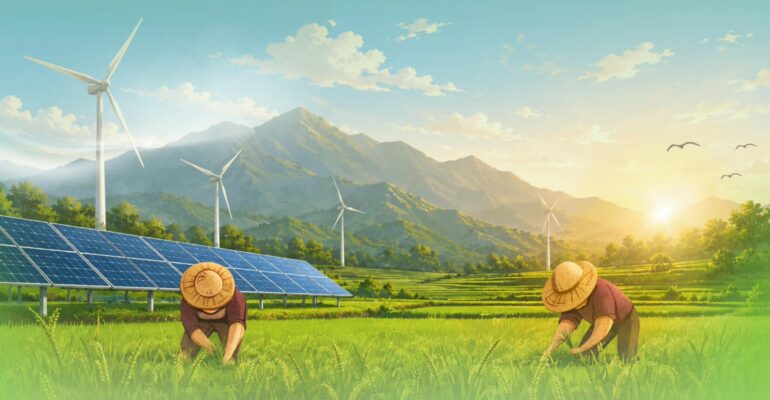
Climate Change and Its Impacts on Food Security
Based on current climate change conditions, changes in temperature and weather patterns are known to affect food security. Indonesia’s average air temperature in 2024 reached 27.5°C, approximately 0.8°C higher than the 1991–2020 normal average. Based on observations from 1981 to 2024, 2024 was also recorded as the hottest year in Indonesia (BMKG, 2025). These conditions can place pressure on the agricultural sector, as changes in temperature and rainfall can affect planting seasons, water availability, crop productivity, and the risk of crop failure. A study by Rosalia and Mulyaningsih (2022) found that changes in temperature and rainfall can affect agricultural production and, consequently, food security.
The impacts of climate change on food extend beyond production volumes to food prices and people’s ability to access food. When production declines, food availability may decrease, potentially driving up prices. This poses a greater risk to low-income communities because of their limited purchasing power. According to The State of Food Security and Nutrition in the World 2025, food price inflation can reduce purchasing power and make it more difficult for people, particularly those in low-income groups, to access healthy food.
In addition to affecting food prices, climate change can reduce the diversity of foods consumed by communities. When nutritious food becomes less accessible, people may become more dependent on relatively inexpensive and filling foods. UNICEF Indonesia (2024) explains that rising temperatures, unpredictable rainfall patterns, and extreme weather events can disrupt food systems and increase the risk of food insecurity and nutritional problems, particularly among children and low-income families. Therefore, food security is not only about food availability but also about access to safe, diverse, and nutritious food.
Climate Change and Public Health
Based on its impacts, climate change can affect public health both directly and indirectly. This can be seen in the increased risks associated with extreme heat, floods, droughts, storms, as well as disruptions to food and water availability. According to WHO (2024), climate change can increase the risk of various health problems, including vector-borne and waterborne diseases, as well as disruptions to healthcare services and sanitation. Children, older people, low-income communities, and people living in vulnerable areas may face greater risks.
Certain groups are more vulnerable to the impacts of climate change. These include people living in vulnerable areas and groups with limited access to resources and healthcare services. According to Sulistiadi et al. (2024), climate change in Indonesia not only has direct health impacts but can also generate social, economic, and cultural consequences that may affect the resilience of the healthcare system. Air quality is also an important aspect of the relationship between climate change and health. The combustion of fossil fuels produces greenhouse gases as well as various air pollutants, such as particulate matter and nitrogen oxides (WHO, 2025).
Reducing fossil fuel use can help lower greenhouse gas emissions while also reducing public exposure to air pollution. This relationship can also be observed through food and nutrition. When climate change disrupts food production, distribution, and prices, people may find it more difficult to access diverse and nutritious food. This demonstrates that climate change, food, the environment, energy, and health are interconnected and need to be considered together.
Why Is the Clean Energy Transition Important?
Given the impacts of climate change on the environment and health, reducing fossil fuel use is one measure that can be taken to lower emissions. This can be achieved through an energy transition, which refers to shifting from an energy system that relies heavily on fossil fuels toward low-emission and renewable energy sources. Renewable energy sources include solar, wind, hydropower, geothermal, and bioenergy.
Indonesia has considerable renewable energy potential. According to data from the Ministry of Energy and Mineral Resources (MEMR, 2023), Indonesia’s total new and renewable energy potential reaches approximately 3,686 GW, comprising solar, wind, hydropower, bioenergy, geothermal, and ocean energy. The Indonesian government has also set a target of achieving Net Zero Emissions by 2060 or sooner with international support, with renewable energy development forming an important part of the strategy to achieve this target.
However, this substantial potential does not mean that the energy transition can take place without adequate preparation. Infrastructure, investment, technology, electricity grids, energy storage systems, and human resources need to be developed simultaneously. Energy must also remain available, reliable, and affordable for the public. Therefore, the energy transition is not only about developing renewable energy power plants but also about ensuring that changes in the energy system benefit agriculture, food systems, the economy, and public health.
The Relationship Between Clean Energy and Food Security
Energy plays a role in almost every stage of the food system. It is used to irrigate farmland, operate agricultural machinery, process crops, store and refrigerate food, and distribute food products. The relationship among food, energy, and water is known as the Food-Energy-Water Nexus. Nugroho (2020) explains that these three sectors are closely interconnected and are also linked to climate change and sustainable development.
Renewable energy can be used to help meet energy needs in the agricultural sector. One example is the use of solar-powered water pumps to support irrigation systems in Keliki Village, Ubud, Gianyar, Bali. According to a report by the Ministry of Energy and Mineral Resources (2022), the pumps were developed in response to limited access to the electricity grid and challenges in irrigating rice fields under certain conditions, particularly during the dry season. This example demonstrates how clean energy can be used to meet needs directly related to food production.
However, the use of renewable energy does not automatically guarantee food security. Its implementation still needs to be adapted to local conditions, water requirements, installation costs, and communities’ capacity to maintain the technology. Nevertheless, more efficient and low-emission energy use can help support agricultural activities. By meeting energy needs for irrigation, processing, storage, and distribution, food systems have the potential to become more resilient to various disruptions.
Clean Energy Transition and Public Health
One of the key public health benefits of the clean energy transition is the reduction of sources of air pollution. Fossil fuel combustion produces greenhouse gases as well as various air pollutants. Mitigation measures that reduce fossil fuel combustion can generate health co-benefits because greenhouse gas emissions and air pollution often originate from the same activities.
Reducing fossil fuel use can help lower public exposure to air pollutants while simultaneously reducing greenhouse gas emissions. This can benefit public health and help mitigate climate change over the long term. Climate change itself can affect various fundamental determinants of health, including access to food, water, shelter, and healthy environmental conditions.
The relationship between energy and health can also be observed within the food system. Food production, processing, storage, refrigeration, and distribution all require energy. Using cleaner energy sources in these processes can help reduce emissions while supporting a more sustainable food system. However, renewable energy development still requires land, materials, financing, and infrastructure. Its implementation must therefore take environmental and social conditions into account to avoid creating new problems.
Challenges of the Clean Energy Transition in Indonesia
Indonesia has significant potential for an energy transition, but it still faces various challenges. These include the need for investment, infrastructure development, electricity grid expansion, energy storage technologies, and human resources to support renewable energy deployment. Continued dependence on fossil fuels also means that the transition cannot happen instantly, as the existing energy system has long involved industries, workers, investments, and established patterns of energy consumption.
Another challenge is ensuring equitable access to energy. Clean energy development should not be concentrated solely in urban and industrial areas but should also reach communities with limited energy access. In the agricultural sector, solar-powered pumps are one example of a technology that can support areas with limited electricity grid access. However, their implementation still needs to consider installation costs, maintenance capacity, energy requirements, geographical conditions, and resource availability.
Social and economic considerations must also be taken into account throughout the transition. Energy is a basic necessity for daily activities and economic development, meaning that changes to the energy system must ensure that energy remains available, reliable, and affordable. Therefore, the success of the energy transition is determined not only by technological advancement but also by the ability to ensure that the benefits of clean energy are shared equitably across society.
The Role of Government, Communities, and Young People
The government has an important role in creating a system that supports clean energy adoption. This can be achieved through policymaking, infrastructure development, support for research and innovation, human resource development, and financing. Energy policies also need to be integrated with the food, water, environmental, and health sectors because changes in one sector can affect others.
The private sector can contribute by improving energy efficiency, adopting low-emission energy sources, and developing technologies suited to community needs. In the food sector, energy-efficient technologies can be applied to food processing, storage, refrigeration, and distribution. Meanwhile, communities can contribute by using energy more efficiently and reducing food waste. However, behavioral change cannot be the sole solution, as people’s choices are also influenced by prices, availability, infrastructure, and policies.
Young people also have opportunities to contribute through education, research, innovation, and activities that raise awareness of the connections between climate change, energy, food, and health. The involvement of multiple stakeholders is essential to ensure that the energy transition not only focuses on reducing emissions but also delivers tangible benefits to society.
In conclusion, climate change is closely linked to food security and public health. Changes in temperature, rainfall, and extreme weather events can affect food production, food prices, access to nutritious food, air quality, and health conditions. The clean energy transition can be one approach to mitigating these impacts by reducing emissions and air pollution and promoting the use of renewable energy within food systems. However, its success will continue to depend on investment, technology, infrastructure, supportive policies, equitable access, and attention to communities’ socioeconomic conditions. Therefore, Indonesia’s energy transition needs to be implemented gradually and sustainably so that its benefits can be shared more broadly.
Written by: Salwa Hanifa (Research Division)
Source
Badan Meteorologi, Klimatologi, dan Geofisika. (2025, January 3). Anomali suhu udara rata-rata tahun 2024. https://www.bmkg.go.id/iklim/anomali-suhu-udara/anomali-suhu-udara-rata-rata-tahun-2024
Food and Agriculture Organization of the United Nations, International Fund for Agricultural Development, United Nations Children’s Fund, World Food Programme, & World Health Organization. (2025). The state of food security and nutrition in the world 2025: Addressing high food price inflation for food security and nutrition. FAO. https://doi.org/10.4060/cd6008en
Intergovernmental Panel on Climate Change. (2022). Climate change 2022: Impacts, adaptation and vulnerability: Chapter 5—Food, fibre and other ecosystem products. Cambridge University Press. https://www.ipcc.ch/report/ar6/wg2/chapter/chapter-5/
Kementerian Energi dan Sumber Daya Mineral Republik Indonesia. (2022, March 24). Empat kerjasama menuju Net Zero Emission tahun 2060 ditandatangani. https://www.esdm.go.id/en/media-center/news-archives/empat-kerjasama-menuju-net-zerro-emission-tahun-2060-ditandatangani
Kementerian Energi dan Sumber Daya Mineral Republik Indonesia. (2022, August 22). Pompa air tenaga surya hadir, irigasi sawah Wayan lancar mengalir. https://www.esdm.go.id/id/media-center/arsip-berita/pompa-air-tenaga-surya-hadir-irigasi-sawah-wayan-lancar-mengalir
Kementerian Energi dan Sumber Daya Mineral Republik Indonesia. (2023, February 4). Miliki potensi EBT 3.686 GW, Sekjen Rida: Modal utama jalankan transisi energi Indonesia. https://esdm.go.id/en/media-center/news-archives/miliki-potensi-ebt-3686-gw-sekjen-rida-modal-utama-jalankan-transisi-energi-indonesia
Nugroho, H. (2020). Memperkokoh keterkaitan ketahanan pangan, energi, dan air (Food-Energy-Water Nexus) dalam perencanaan pembangunan Indonesia. Bappenas Working Papers, 3(2), 238–243. https://doi.org/10.47266/bwp.v3i2.80
Rosalia, A. C. T., & Mulyaningsih, T. (2022). Climate change impact on food security: A review. Sustinere: Journal of Environment and Sustainability, 6(3), 227–238. https://doi.org/10.22515/sustinerejes.v6i3.239
Sulistiadi, W., Wasir, R., Thalib, W., Ayuningtyas, D., Bawazier, N., et al. (2024). Building health systems resilience: Understanding the social, economic, and cultural impacts of climate change from stakeholders’ perspectives in Indonesia. Archives of Public Health, 82, 168. https://doi.org/10.1186/s13690-024-01403-4
UNICEF Indonesia. (2024). Climate change and nutrition in Indonesia: A review of the evidence for policy and programme strengthening. https://www.unicef.org/indonesia/nutrition/reports/climate-change-nutrition-indonesia
World Health Organization. (2024). Guidance on climate change and health. https://www.who.int/tools/compendium-on-health-and-environment/climate-change
World Health Organization. (2025, July 17). Health and air pollution co-benefits of climate change mitigation: Science and policy snapshots on air quality, energy and health. https://www.who.int/publications/i/item/B09460
