
Sunday, June 2, 2024. Long before the sun’s heat was too intense, a crowd of students, the general public, environmental CSOs, and several elderly people had lined up at the Kendal Tunnel, Central Jakarta. They aimed to voice their aspirations and thoughts on increasing the implementation of renewable energy at the community level. They have long had a strong interest in implementing renewable energy in their homes, however, the unaffordable price of solar power plants and the government’s lack of support for purchasing schemes have become major obstacles for them to start implementing them. Furthermore, the policy of eliminating the Nett Metering scheme has also made people as consumers of rooftop solar power plants feel they are losing the added value of being able to experience the benefits of using rooftop solar power plants. In addition to potential consumers, many students also joined the 2050 Emission-Free Indonesia Parade, they have been enlightened through communication and information media and they are moved to do something for the sustainability of Indonesia’s earth. Moreover, they also feel threatened by the coal-fired power plants surrounding Jakarta, the black smoke, and the air quality, which is often worse than better, increasing the threat of respiratory illnesses felt by all residents of the capital. Not only in the capital, but IBEKA, an organization that advocates for renewable energy use in various remote areas of Indonesia, also complains about the lack of government support and funding innovation for renewable energy implementation programs in remote areas that lack access to electricity from PLN. In some locations, PLN actually poses a threat to renewable power plants. These voices from the community and students inspired the Indonesia Zero Emissions 2050 Coalition to create a Parade and Policy Recommendations for the progressive and equitable implementation of renewable energy for all Indonesians.
Around 350 participants took part in the Indonesia Zero Emissions 2050 Parade, including environmental CSOs (Enter Nusantara), ITDP, IBEKA, and Climate Ranger, as well as students from the Student Executive Board (BEM) of the Faculty of Law, University of Indonesia (UI). In addition, a number of members of the general public, aged 10-60, also joined the parade. Gathering at 6:00 a.m. Western Indonesian Time (WIB), the marchers were welcomed by the Coordinator of the Clean Resources Hub, Irwan Sarifudin; the Chair of the Clean Energy Generation, May Lynn; and the Deputy Coordinator of the Environmental Agency (DLH), BEM FH UI, Wahyu Ilham Pranoto. Around 7:30 a.m., the marchers began moving to the Hotel Indonesia Roundabout, carrying messages of the fight for renewable energy. They displayed posters promoting emission reductions made from used cardboard, a globe with a wind turbine, banners, and chants along the way. The purpose of the parade was not only to criticize the government but also to raise awareness among the approximately 35,000 visitors to the Jakarta CFD (Civil Service Day Festival) to favor renewable energy over dirty energy.
After walking for approximately an hour, the marchers arrived at the Hotel Indonesia Roundabout, where all participants marched in an orderly manner, not neglecting the public interest in using the CFD route for exercise. The parade mass circled the HI roundabout once to maximize the momentum for strengthening the emission reduction movement.
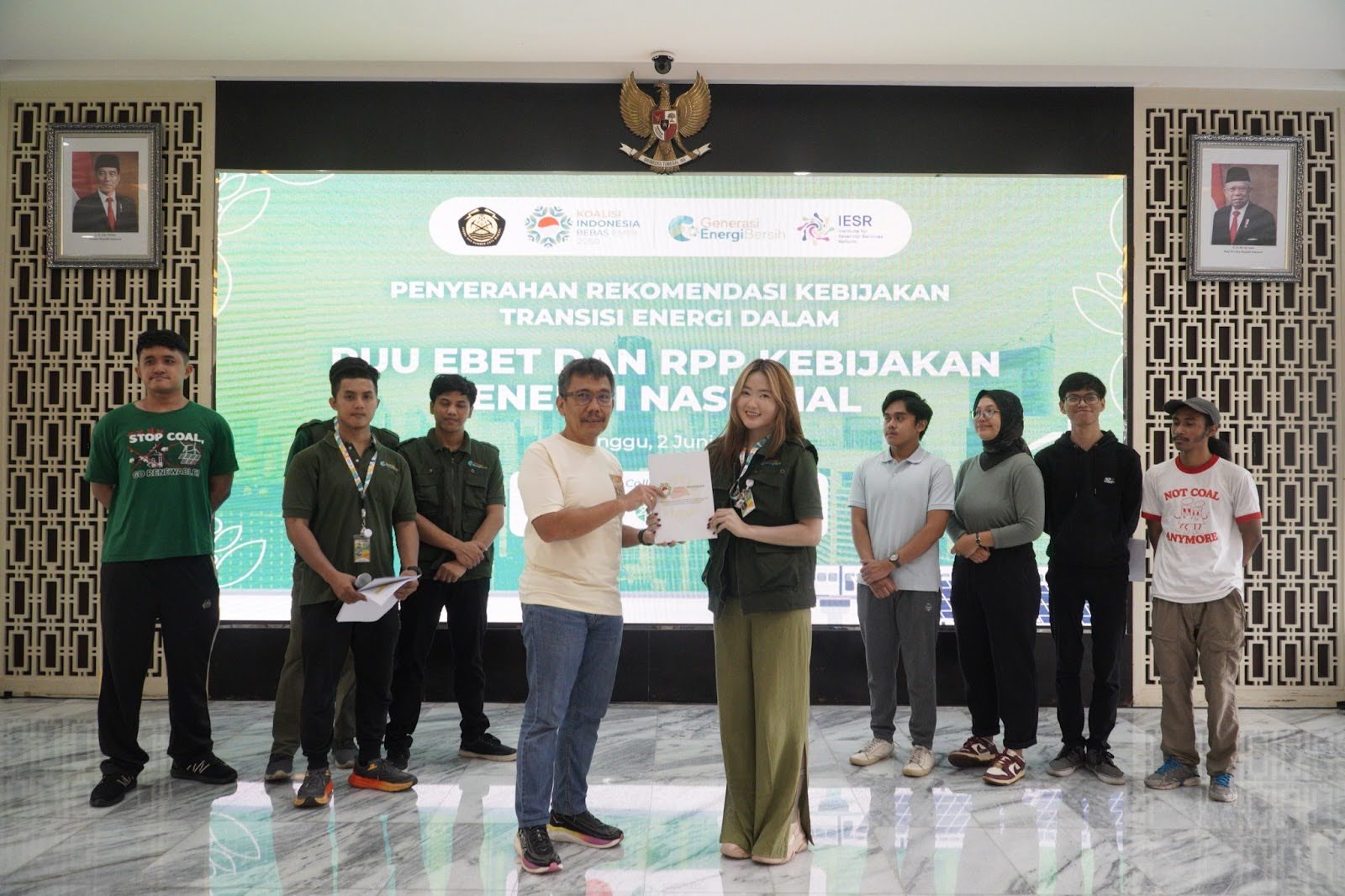
Afterward, at 9:00 a.m. Western Indonesian Time (WIB), the crowd moved directly to the Ministry of Energy and Mineral Resources office to deliver Policy Recommendations directly to ESDM officials. These Policy Recommendations include:
- Promoting energy democratization by providing access to quality energy, providing incentives and facilitating the installation of rooftop solar power plants (PLTS), providing easy and attractive renewable energy financing schemes for the public, and updating the Energy Independent Village (Desa Mandiri Energi) regulation with incentives and disincentives.
- Enhancing the government’s commitment to providing clean energy for the people by targeting a high energy mix in the National Energy Policy (KEN), relaxing the Domestic Component Level (TKDN) regulations for solar power plant components and other renewable energy sources. Furthermore, KIBE 2050 encourages the use of environmentally friendly energy storage systems such as pumped hydro energy storage (PHES).
- Reducing emissions in the energy sector through early retirement of coal-fired power plants (PLTU) and avoiding cofiring at PLTUs, evaluating plans to implement carbon capture storage (CCS)/carbon capture utility storage (CCUS) at coal-fired power plants, implementing a carbon tax, and shifting subsidies from dirty energy to clean energy.
- Achieving a just transition by providing support to affected workers, preparing leading sectors to replace fossil fuels, and strengthening coordination with all relevant agencies to achieve NZE by 2050.
Details can be downloaded from the following link:
In the Sarulla Hall, Ministry of Energy and Mineral Resources Office, Central Jakarta, KIBE 2050 was received by Mr. Agus Cahyono Adi as Head of the Bureau of Communication, Public Information Services and Cooperation (KLIK), KESDM who also appreciated and accepted the KIBE 2050 recommendation. He stated that his party would follow up on the recommendation. The KIBE 2050 movement will not stop here. We will also try to hold a public hearing with the House of Representatives Commission VII and the National Energy Council. Let’s help support the Clean Energy Generation movement with KIBE2050 by following the latest information from us on Instagram @genergibersih.
