
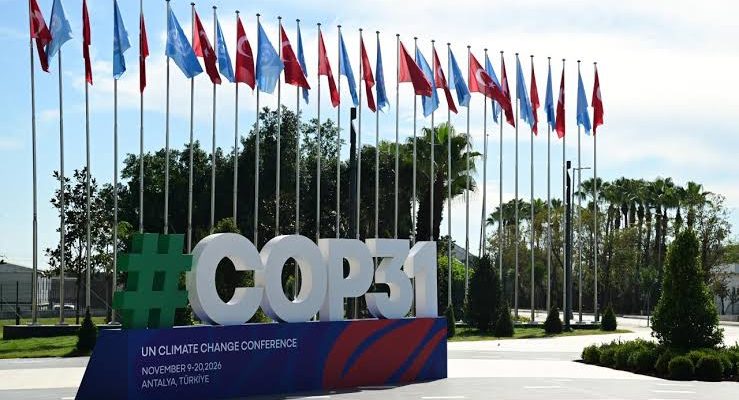
Jakarta, November 12, 2026 – The 31st Conference of the Parties (COP31) is taking place in Antalya, Turkey, from November 9–20, 2026. The COP is an annual forum for member states of the United Nations Framework Convention on Climate Change (UNFCCC) to assess progress in addressing climate change.
This year, COP31 President Murat Kurum, who is also Turkey’s Minister of Environment, Urbanization, and Climate Change, is carrying the theme “Implementation COP,” which aims to encourage the actual implementation of existing climate agreements. So, what will be discussed, and what does Indonesia need to bring to the table to ensure it doesn’t just come with targets?
COP31 Main Agenda
Chris Bowen, President of Negotiations at COP 31 and Australia’s Minister for Climate Change and Energy, stated that there are more than 160 items on the agenda. Here are four of the main ones.
First, the Just Transition Mechanism, a mechanism to ensure the transition to clean energy doesn’t leave workers and communities behind. For Indonesia, this issue concerns workers and coal-producing regions.
Second, the Mitigation Work Programme, a work program under the UNFCCC to accelerate the reduction of greenhouse gas emissions. For Indonesia, this issue relates to emissions from the energy and industrial sectors, which are projected to continue rising until 2030.
Third, climate change adaptation, namely measures to protect communities from impacts already being felt, such as floods and droughts. A United Nations Environment Programme (UNEP) report states that developing countries need approximately US$305 billion (approximately Rp5,511 trillion) per year for adaptation, while international public funds by 2024 are only around US$28.2 billion (approximately Rp510 trillion), less than a tenth of that.
Fourth, climate finance, particularly how to achieve the New Collective Quantified Goal (NCQG) resulting from COP29 in Baku. Developed countries will take the lead in mobilizing a minimum of US$300 billion (approximately Rp5,420 trillion) per year for developing countries by 2035, while all parties are encouraged to increase this to US$1.3 trillion (approximately Rp23,488 trillion) per year from all sources.
Beyond negotiations, the COP31 Presidency proposed a voluntary “35-by-35” global electrification target. The target is to increase the share of electricity in global final energy consumption from around one-fifth to 35 percent by 2035, based on analysis by the International Energy Agency (IEA) and the International Renewable Energy Agency (IRENA).
35 Percent Electrification, a Major Leap for Indonesia
According to the IESR, to achieve this target, Indonesia’s electricity consumption needs to increase from 455 terawatt hours (TWh) in 2025 to 971 TWh in 2035, or approximately 8 percent per year. In other words, within ten years, Indonesia must add approximately 516 TWh, greater than the entire national electricity consumption in 2025.
Agus Praditya Tampubolon, Director of the IESR Climate and Just Energy Transition Program, assessed that electrification of transportation, households, and industry can strengthen economic resilience when fuel supplies are disrupted. The prerequisite is that the additional electricity demand must be supplied by renewable energy, because if it remains dominated by fossil fuels, electrification could actually prolong dependence on coal.
Steps Indonesia Needs to Take
Targets alone are not enough. The Climate Action Tracker still assesses Indonesia’s climate action as critically insufficient to keep temperature rise below 1.5°C. Therefore, the IESR emphasized three points that align with the Antalya agenda.
First, renewable energy generation capacity needs to triple by 2030. Presidential Regulation No. 112 of 2022 already limits new coal-fired power plants (PLTU), but still provides an exception for captive PLTUs, namely those for domestic industrial needs. IESR recommends phasing out new captive PLTUs after 2030 and accelerating the retirement of older, inefficient PLTUs. This step needs to be accompanied by the installation of electricity grids and energy storage to ensure optimal operation of additional renewable energy.
Second, Indonesia needs to promote more affordable and accessible climate financing, for example through grants. These funds are needed for renewable energy, electricity grids, energy storage, and the early retirement of PLTUs.
Third, a just transition needs to be prepared for coal-producing regions. IESR emphasizes social protection, retraining, and job creation for affected workers.
Indonesia’s role at COP31 should be measured by progress in domestic implementation, not by announced commitments. This means that updating targets alone is insufficient without concrete policies and measurable emission reductions.
