
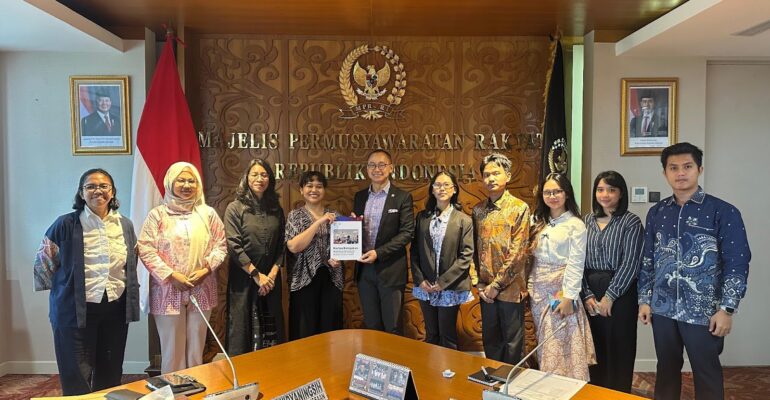
Jakarta, Thursday (5/3/2026) — The Indonesia Youth Coalition to Climate Actions (YOU CAN), alongside Rumah Kebangsaan, Yayasan Indonesia Bebas Emisi (YIBE), Generasi Energi Bersih (GEN-B), Koalisi Kopi Waingapu NTT, Ana Humba Community, and Enter Nusantara, held an audience with the Vice Chairman of the MPR RI, Eddy Soeparno. The meeting, which took place at the Parliament Complex in Senayan, Jakarta, aimed to present policy analysis and recommendations regarding the Draft Law on Climate Change Management (RUU PPI) while pushing for the strengthening of climate education in Indonesia. This dialogue is part of an effort to bolster civil society involvement in the formulation of more comprehensive and participatory national climate regulations.
Climate change itself has become a global priority driven by various international institutions such as the United Nations Framework Convention on Climate Change and the United Nations Development Programme. Through the global commitment in the Paris Agreement, countries worldwide, including Indonesia, have agreed to keep the global temperature rise below 2°C and strive to limit it to 1.5°C compared to pre-industrial levels.
As part of this commitment, Indonesia has established several national policy frameworks, including Law Number 32 of 2009 on Environmental Protection and Management, Law Number 16 of 2016 on the Ratification of the Paris Agreement, and Presidential Regulation Number 98 of 2021 on the Implementation of Carbon Economic Value. The government has also set emission reduction targets through the Nationally Determined Contribution (NDC) document at 31.89 percent independently and up to 43.2 percent with international support by 2030.
In this context, the discussion of the Draft Law on Climate Change Management is seen as a crucial step to strengthen the national legal framework in the governance of climate change mitigation and adaptation, while ensuring that the transition toward low-emission development proceeds in a structured and equitable manner.
During the audience, the Lead Coordinator of YOU CAN, Friliana Susanto, submitted several inputs for the RUU PPI, which is considered to have the potential to be a strategic instrument in integrating cross-sectoral policies. According to her, this regulation is expected to serve as a legal umbrella for various agendas, from energy transition and ecosystem protection to strengthening the social resilience of communities affected by the climate crisis.
Meanwhile, the Coordinator of Rumah Kebangsaan, Erika Widyaningsih, highlighted that although Indonesia already has a legal basis through Law Number 32 of 2009, that framework is deemed insufficient to fully address the current complexities of the climate crisis. She believes the discussion of the RUU PPI needs to expand its approach to not only focus on carbon economic value but also to strengthen civil society participation and clarify institutional relationships between the government, the private sector, and local communities.
Beyond regulatory aspects, the meeting also emphasized the importance of integrating climate education as a foundation for social transformation toward low-emission development. Strategic Partnership of Yayasan Indonesia Bebas Emisi, Riyan Nurrahman, stated that climate change management policies must be able to address social dynamics at the community level.
“Through a gamification approach in learning pedagogy at schools and universities integrated within the Climate Change Management Bill (RUU PPI), the government should be able to present a perspective that favors the community. Teachers and students can understand more concretely the detrimental impacts of poorly mitigated climate change, as well as the benefits of using renewable energy for environmental sustainability and macro and micro-economic growth. Thus, the community will no longer view renewable energy projects, including geothermal, as a threat of land conversion or a loss of livelihoods,” Riyan said.
He added that climate change policies also need to be linked with economic opportunities for the community so that the energy transition process can be more inclusive. “The government also needs to clarify schemes for purchasing clean energy from the community—whether sourced from solar, water, wind, or the currently prevalent biomass energy—to the nearest PLN/Private power generation sources, which could potentially be facilitated through the Koperasi Merah Putih.”
Responding to these various inputs, the Vice Chairman of the MPR RI, Eddy Soeparno, expressed his appreciation for the contributions of civil society and the younger generation in enriching the national climate policy discourse. According to him, collaboration between the government, academia, communities, and civil society organizations is a vital element in building inclusive and sustainable climate policies.
Eddy also emphasized that strengthening climate change regulations must be accompanied by increasing public literacy regarding sustainability and energy transition issues. Climate education is seen as a strategic instrument to build public awareness while preparing the younger generation to face future climate change challenges. He also mentioned that the idea of forming a Climate Change Management Agency is currently being discussed internally and is still in the discussion stage.
In the meeting, Yayasan Indonesia Bebas Emisi, through YOU CAN, also submitted five recommendations in a Climate Education Policy Letter covering aspects of Decertification, Evaluation, Collaboration, Education, and Gamification. The policy paper document can be accessed via the link: Kertas Kebijakan Pendidikan Iklim.pdf.
This audience is expected to be an initial step in strengthening the synergy between civil society and policymakers in formulating more participatory national climate regulations. With an approach that prioritizes social justice, various parties hope that Indonesia can accelerate the transformation toward sustainable and low-emission development.
