
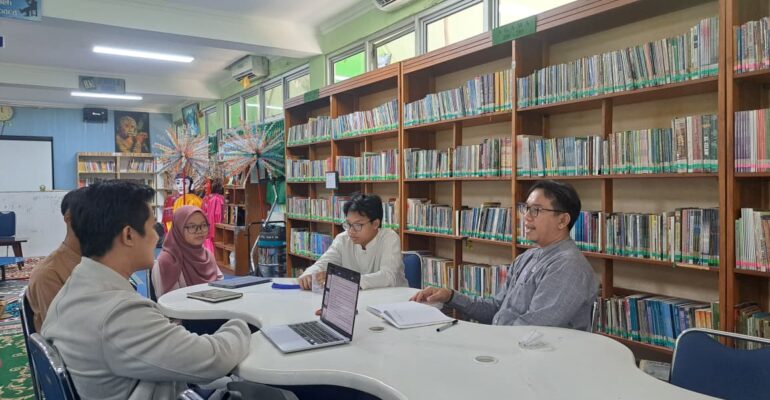
“We currently need a young generation proficient in science and technology with an environmental perspective, capable of curbing the rate of the greenhouse gas (GHG) effect caused by carbon dioxide emissions.”
- Prof. H. Emil Salim, S.E., M.A., Ph.D.
State Minister for Development Supervision and Environment of the Republic of Indonesia (1978–1993)
The quotation highlights the urgent need for Indonesian students to develop and adopt low-emission technologies as part of broader efforts to reduce greenhouse gas emissions and promote healthier, more sustainable communities. However, the implementation of such initiatives remains constrained by several significant challenges, including rising temperatures associated with climate variability and El Niño events, as well as limited fiscal capacity and access to financial resources. These constraints can hinder the ability of educational institutions and students to translate environmental awareness and technological innovation into practical climate action. Therefore, an important question emerges: how can these structural, climatic, and financial barriers be addressed to create an enabling environment in which students can effectively contribute to low-emission technology development and the transition toward sustainable communities?
The Indonesian National Board for Disaster Management (BNPB) recorded the highest temperature in Jakarta as 35.6 degrees Celsius on March 14–15, 2026. The Indonesian National Standard (SNI 03-6572-2001), which sets the thermal comfort zone for air-conditioned interiors at 22.8°C to 25.8°C for optimal comfort, with 27.1°C marking the upper limit of acceptable comfort. So how does the school environment provide a low minimum quality education for helping the Indonesian government achieve the NDC targets?
“Classroom temperatures vary widely from room to room, with settings ranging from a cool 20°C to 26°C, while others, where air-conditioning units are out of order, swelter at 28°C to 30°C,” said Daron Alfa Agustinus Rahardianto a history Teacher and Guidance of the HISTOLOKA (History extracurricular) program at SMAN 68 Jakarta.
Even though more than 27.1°C occurs only a few times, extreme heat that disrupts students’ concentration can be a primary cause of declining academic performance. The Physics Laboratorium at SMA Negeri 68 Jakarta does not have air conditioning. Students often prefer studying in the library, which is equipped with 2 air conditioners. In the stuffy assembly hall, 60 students sit packed together in dim lighting. Ceremonies and sports competitions cannot be held effectively. Although the school has a greenhouse that serves as a learning facility for biology and hydroponic vegetable cultivation, its use remains limited and irregular. Its maintenance and continued operation also rely heavily on individual contributions, particularly from Teachers undertaking certification programs and university students participating in internships. Even the highest admission scores for transfer students plummeted dropping to 72 for the Social Sciences stream and 87 for Natural Sciences despite both students believing they could have scored a 90 if they had the testing room featured air conditioning and better airflow.
In 2025 terms of practical implementation, the school is fortunate to have educators with a strong grasp of environmental issues. Mr. Daron, for instance, has established a partnership with the DKI Jakarta Parks and Urban Forestry Agency to carry out a mangrove planting initiative using the species Rhizophora mucronata (commonly known as Bakau Kurap). Meanwhile, the school’s Physics Teacher has taken the initiative to develop a solar-powered induction stove as a hands-on learning tool for classroom experiments. This effort, however, has yet to reach fruition, hampered by limited technical expertise in device fabrication and insufficient funding to procure the necessary raw materials.
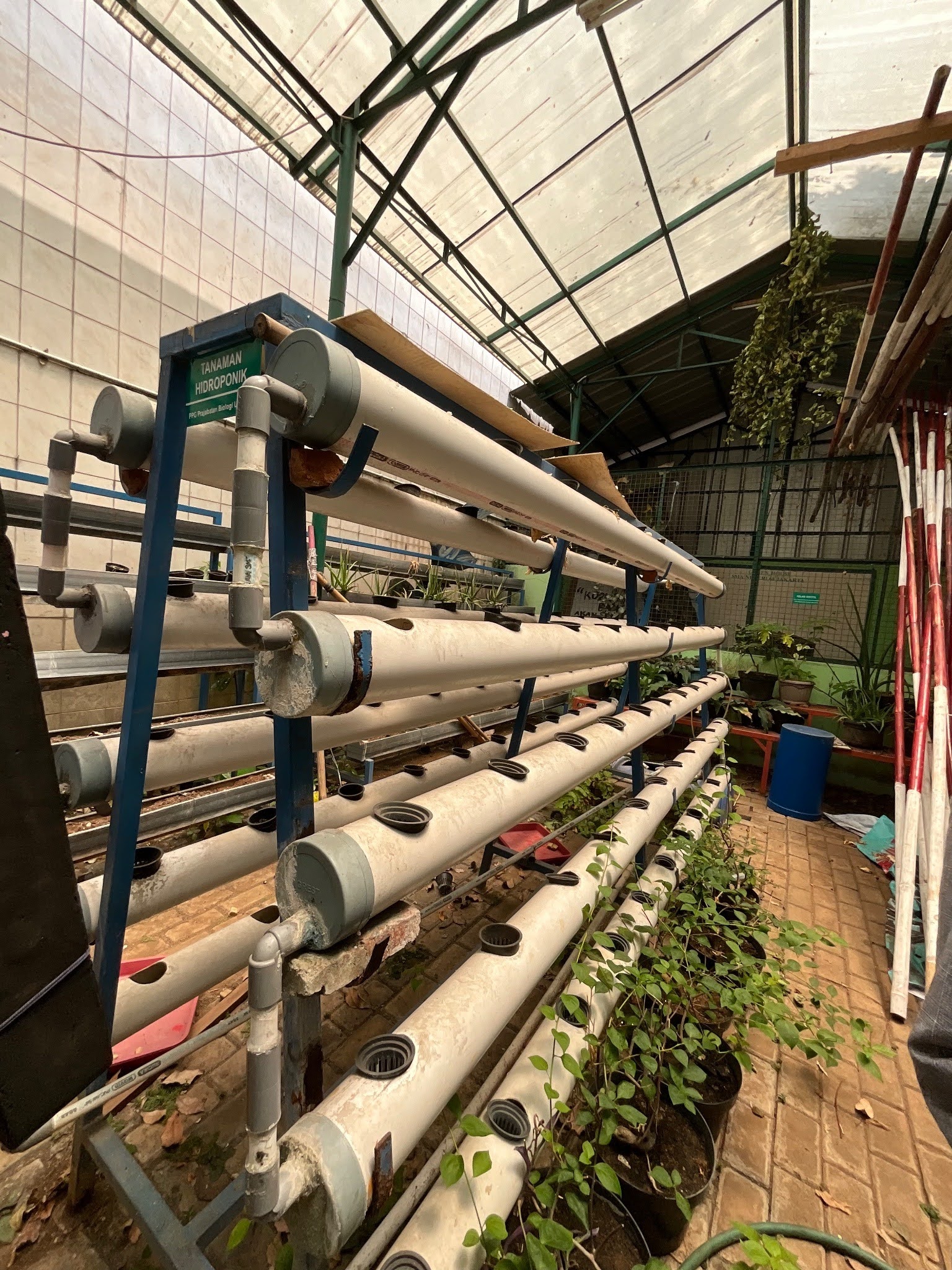
Greenhouse at SMAN 68 Jakarta (Author’s documentation, 2026)
Results from the BIP Test (a fitness assessment conducted with running sport brands) show that one of the male students, named Daffana, reached only level 8 out of his potential at level 11 due to air pollution, while another student, Abizar, stalled at level 6 out of a potential level 8. These Studentsdo not lack stamina, rather, they have lost Physical capacity due to the air they breathe every day. Teachers report other issues as well: eye irritation from dust, sore throats, coughing caused by vehicle exhaust, and skin prone to acne due to daily exposure to heat and pollution. This is no longer an abstract environmental issue, it is a tangible health burden borne by national high school students in Jakarta today.
This is not a snapshot of a neglected school in a remote, underdeveloped province in Indonesia, it is a portrait of a top-tier public school that ranked 10th nationally in 2022. Out of 23.657 schools across Indonesia. According to the Ministry of Education and Culture’s (Kemendikbud) LTMPT rankings. It is a school located in the heart of Jakarta in Salemba Raya only 500 meters walking from RSUP Dr. Ciptomangunkusumo, striving for the Adiwiyata (Green School) award amidst fiscal constraints that have slashed education budgets and a city that is growing increasingly hot.
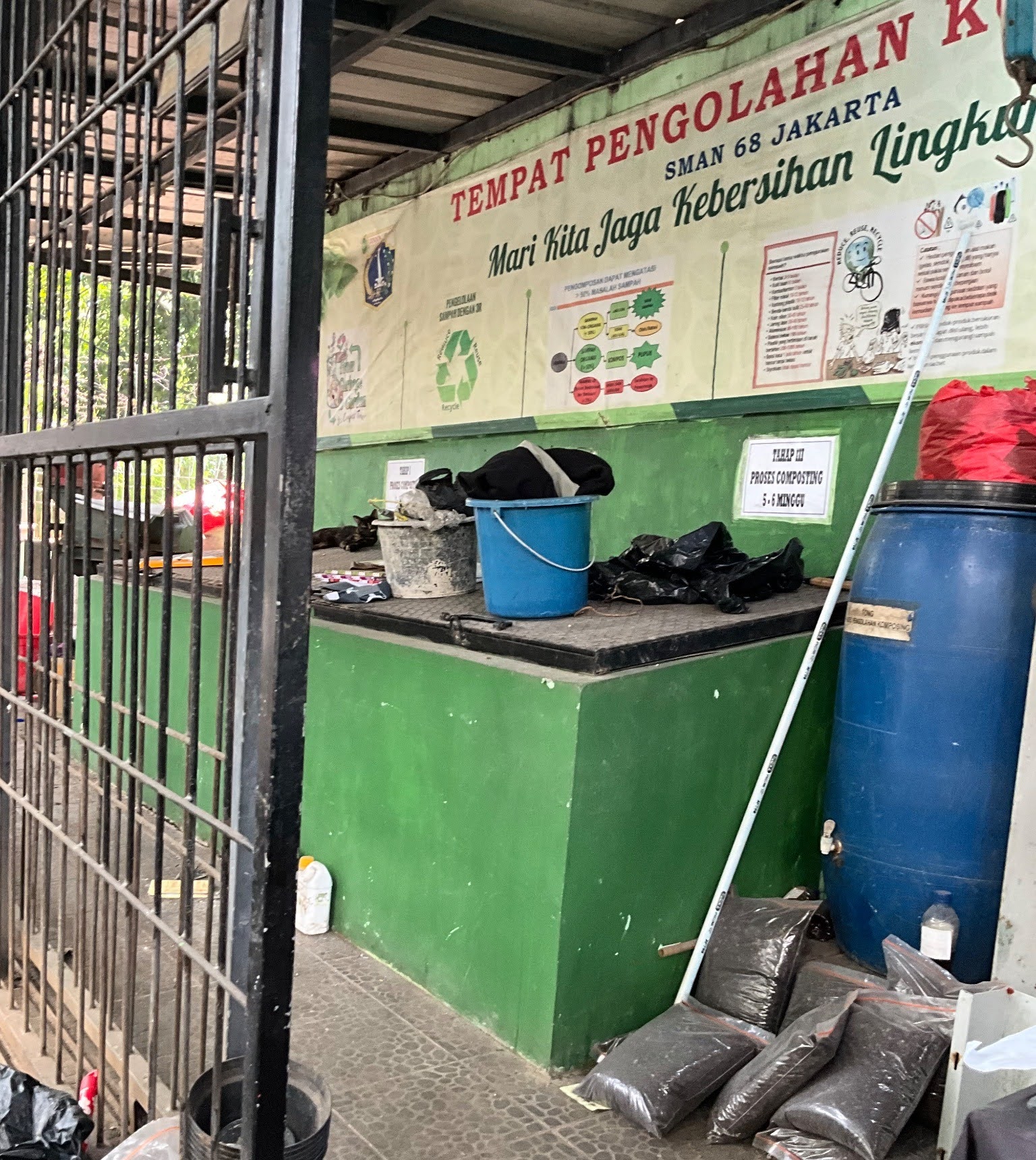
Waste Bank Room at SMAN 68 Jakarta, Author’s Documentation, 2026
These data are not simulations, they stem from direct interviews with students and Mr. Daron Alfa Agustinus Rahardianto., the advisor for the HISTOLOKA (History extracurricular) club at SMAN 68 Jakarta. He is one of millions of Teachers who witness daily how the climate crisis shifts from emission charts into the classroom. It is precisely at this juncture that a critical question regarding Indonesia’s climate policy must be addressed: is our climate and environmental education designed merely to instill awareness, or to build a generation truly prepared to execute the low-carbon energy transition that Indonesia has promised the world by its NDC? Extreme temperatures in cities across Indonesia and Southeast Asia are no longer a matter of seasonal discomfort. They are symptoms of a climate system changing faster than our institutions can adapt. This issue is highlighted by the “Cities on Fire” campaign championed by ChildFund across five Asian cities: Jakarta, Colombo, Bangkok, Manila, and New Delhi. This campaign highlights a recurring pattern: urban heat increases health risks for children, disrupts learning, places a financial burden on households, and widens the inequality gap between communities.
Adiwiyata: A Foundation Not Yet Strong Enough to Support Indonesia’s NDC Ambitions
On paper, Indonesia’s climate ambitions continue to rise. The 2022 updated NDC raised the 2030 emission reduction target from 29% to 31.89% (without international support) and from 41% to 43.20% (with international support). However, Climate Action Tracker rates Indonesia’s overall climate action as “Critically Insufficient”; the unconditional target is deemed “Highly Insufficient,” and even the conditional target remains “Critically Insufficient” when measured against a domestic pathway aligned with the 1.5°C goal. Projections for 2035 indicate that Indonesia’s unconditional pathway could reach 1,830 MtCO₂e more than double what should be Indonesia’s “fair share” of approximately 835 MtCO₂e representing a gap of around 995 MtCO₂e. These figures feel far removed from the classroom. However, UNICEF notes that 15 million Indonesian children have been exposed to heatwaves, 28 million to the risk of coastal flooding, and over 50,000 schools affected by climate-related disasters between 2009 and 2018. This means that every gap in Indonesia’s Nationally Determined Contribution (NDC) represents not merely an emissions statistic, but a tangible risk passed directly onto the desks where our young learners study. If climate policies fail to sufficiently mitigate the risks children face regarding their health, education, safety, and future livelihoods, then the NDC ceases to be just a technical matter of emissions and transforms into an intergenerational policy failure.
The Adiwiyata program has indeed laid an important foundation. By the end of 2023, the government recorded 28,270 Adiwiyata schools across various levels, including 4,650 National Adiwiyata schools and 1,133, Adiwiyata Mandiri (Independent) schools. Yet, in 2024, only 720 schools actually secured the National or Mandiri awards. When compared to the actual scale of the national education system. West Java alone has over 33,000 primary and junior high schools, and East Java nearly 36,000. It is evident that the thousands of Adiwiyata (Green School) schools represent only a small fraction of Indonesia’s national educational assets. The case of SMAN 68 Jakarta illustrates why this disparity exists. The school has implemented nearly all the elements assessed in the Adiwiyata competition: climate education based on a handbook developed with the State University of Jakarta (UNJ), composting, a greenhouse, mangrove planting, a ban on single-use plastic bottles, library digitization to reduce paper waste, campaigns promoting walking and rotating aerobic exercise sessions by grade level, literacy projects focused on environmental figures, and even a fine system for students who damage plants alongside CCTV surveillance to monitor compliance. The school even achieved the City-level Adiwiyata award for Central Jakarta in 2019.
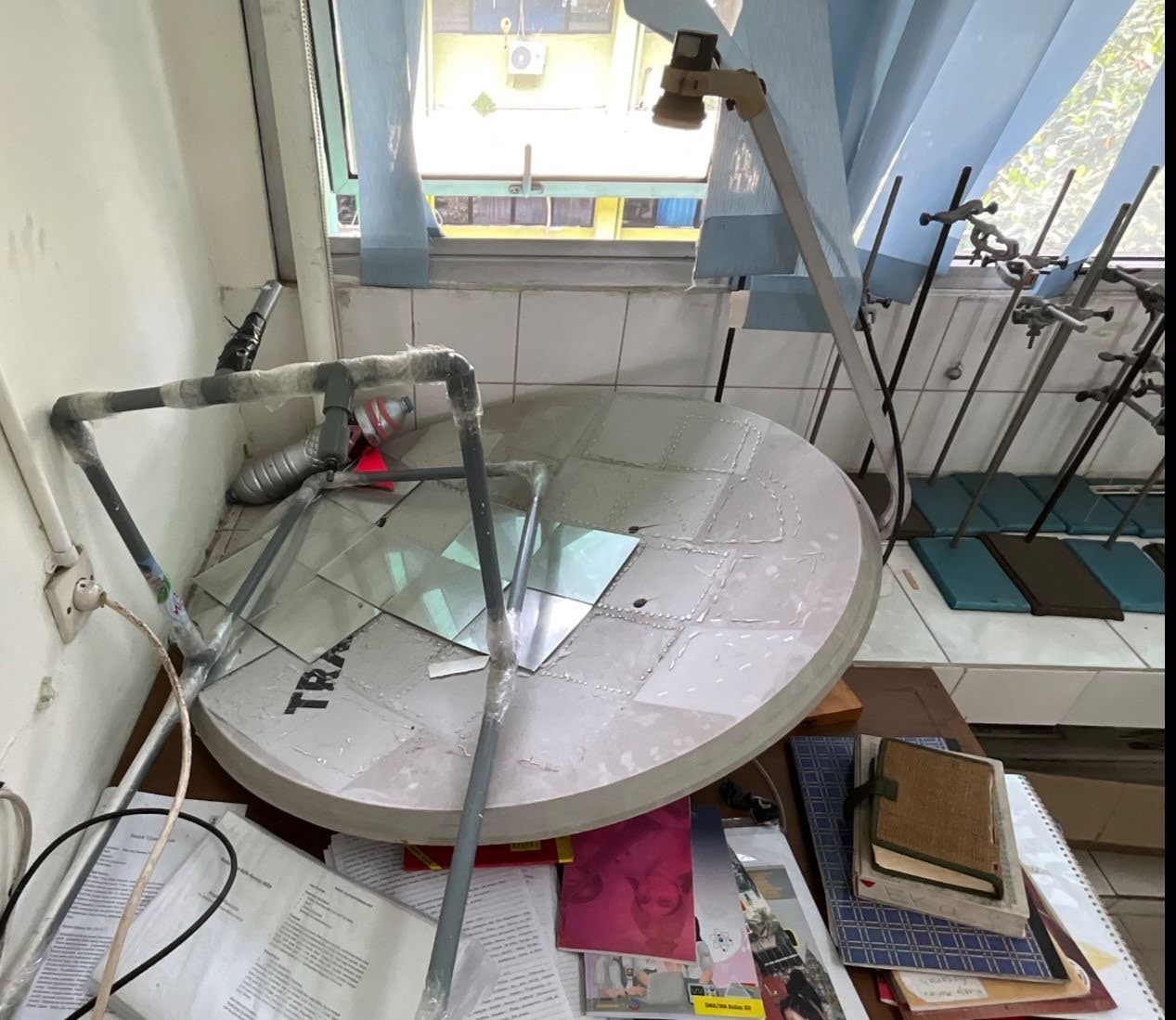
Solar-powered induction stove at the Physics Laboratory of SMAN 68 Jakarta; author’s documentation, 2026.
Beneath the surface, infrastructure capacity remains uneven, only some laboratories are air-conditioned, the Physics laboratory lacks air conditioning, broken AC units take a very long time to be repaired, and the assembly hall becomes stifling when sixty students gather inside. Students have reported they are feeling “somewhat distressed” and overheated while taking exams in rooms lacking adequate ventilation. This serves as tangible proof of what government data itself indicates: the effectiveness of the Adiwiyata program is a function of institutional capacity, fiscal support, teaching staff capabilities, school infrastructure, and government oversight and assessment rather than merely serving as marketing jargon for “clean and environmentally conscious” schools.
A national-scale school greening program Adiwiyata that lacks a focus on reducing carbon emissions will not significantly impact Indonesia’s Nationally Determined Contributions (NDC).
The next generation of the Adiwiyata program needs to shift its focus: moving beyond merely counting certified schools to measuring student climate literacy, actual reductions in institutional emissions, and the genuine establishment of climate resilience. To build a tangible “net-zero emissions” movement within schools, there must be a concerted, measurable, and nationwide effort to reduce emissions. A prime example is the reduction in water consumption observed in 2023; government monitoring of 551 “National” and “Independent” Adiwiyata schools revealed a drop in water usage from 212 million m³/month to 63 million m³/month an efficiency gain of approximately 70%. This demonstrates that school-based greening programs can yield measurable, real-world results, provided they are backed by a consistent monitoring system rather than just an annual administrative checklist.
Indonesia certainly does not lack the legal framework required for decisive action. Through Law No. 16 of 2016, Indonesia ratified the Paris Agreement, which the government had signed in New York on April 22, 2016. This ratification legally binds Indonesia to fulfill the Agreement’s obligations, including meeting national emission reduction targets, submitting national contributions every five years, aligning mitigation and adaptation policies, and adhering to transparency frameworks regarding emissions reporting and international support. In other words, Law No. 16/2016 is not merely a diplomatic symbol; it represents a legally binding commitment across all sectors—including education, a sector that has historically been rarely mentioned explicitly in discussions regarding the implementation of Nationally Determined Contributions (NDCs).
In fact, positive initiatives have already emerged from within the education sector. In August 2024, the Agency for Educational Standards, Curriculum, and Assessment (BSKAP) under the Ministry of Education, Culture, Research, and Technology launched a Climate Change Education Guide as part of the Kurikulum Merdeka (Independent Curriculum). This guide adopts principles and an approach encapsulated by the acronym RAMAH: standing for Relevant (Relevant), Afektif (Affective), Merujuk Pengetahuan (Knowledge-based), Aksi Nyata (Concrete Action), and Holistik (Holistic). It deliberately avoids treating climate change as a standalone subject; instead, it integrates the topic into intracurricular, co-curricular (such as the Project to Strengthen the Pancasila Student Profile), and extracurricular activities like the Scouts. Developed through a participatory process since mid-2023, the guide involved a wide range of stakeholders, including local governments, school principals, Teachers, parents, and development partners. Notably, SMAN 68 Jakarta had already been organically embodying the spirit of RAMAH long before the term gained popularity through collaborations with the Environmental Agency and the Sub-agency of Education for assessments and “urban scouting,” tangible mangrove planting projects, and the HISTOLOKA (History Extracurricular) group, which serves as a platform for fostering students’ ecological awareness. What remains to be done is to link these school-level best practices with national legal mandates, ensuring that the efforts of an extracurricular Guidance in Central Jakarta are truly recognized as a concrete contribution to Indonesia’s Nationally Determined Contributions (NDC) targets, rather than merely serving as an annual ceremonial activity.
Generasi Energi Bersih (Gen-B) Suggested steps to be taken:
Adiwiyata provides a foundation, but the next generation of environmental education must go further: moving from awareness to capability, from capability to action, and from individual action to structural, systemic transformation. This entails: Aligning the curriculum with NDCs. Content must shift from basic waste management and conservation toward climate literacy, renewable energy, sustainable mobility, energy efficiency, the circular economy, and community-based projects. All directly aligned with Indonesia’s long-term low-carbon pathway.
Schools as living laboratories. Students monitor energy use, calculate their institution’s emissions, develop small-scale renewable energy projects, and assess local climate risks much like the initiatives pioneered by SMAN 68 Jakarta through their greenhouse and composting programs. Physical infrastructure as a prerequisite, not an afterthought. Stifling classrooms and unventilated laboratories are not merely issues of comfort; they are direct barriers to learning outcomes and student health. This is evidenced by the performance gap scores of 72 versus 90 observed between non-air-conditioned rooms at SMAN 68 and student learning targets.
Monitoring linked to national climate policy indicators. Rather than stopping at certification labels, monitoring should track tangible successes such as the 70% water efficiency achieved by Adiwiyata schools in 2023. A stronger focus on the affective dimension. Education observers note that current BSKAP guidelines do not emphasize the affective or socio-emotional aspects of climate change education. Yet, this dimension is crucial in addressing the sense of distress students feel when studying in hot conditions as reported by Teachers at SMAN 68. This issue requires a response that addresses not only Physical needs but psychological ones as well. Every year without concrete action means another cohort of students learning in stifling assembly halls, another group losing lung capacity on polluted running tracks, and another generation inheriting a 995 MtCO₂e gap they didn’t create. Indonesia already possesses Law No. 16/2016 as a binding legal framework and the Climate Change Education Guidelines from BSKAP as a technical framework for schools. What is missing is a policy bridge connecting the two: a mechanism that transforms schools from being recipients of climate impacts into active, measurable partners in achieving Indonesia’s Nationally Determined Contributions (NDC).
For the Ministry of Education, Culture, Research, and Technology (Kemendikbudristek) and BSKAP: strengthen the Climate Change Education Guidelines with indicators directly linked to NDC targets—rather than just curriculum outcomes—and strengthen the affective dimension to address the psychological stress students face due to substandard learning conditions.
For the Ministry of Environment and Forestry (KLHK) and local governments: make budget allocations for school infrastructure (ventilation, energy-efficient air conditioning, shaded areas) an explicit part of regional climate adaptation strategies, rather than a separate budget item competing with other needs.
For the House of Representatives (DPR RI), particularly the commissions overseeing the environment and education: push for a revision of the Adiwiyata (Green School) framework to align with the transparency reporting obligations under Law No. 16/2016, ensuring that school contributions can be formally recognized in national NDC reports.
For schools, Teachers, and communities like HISTOLOKA (History extracurricular) SMAN 68 Jakarta: continue your existing best practices—and make your voices heard by policymakers—because data from your classrooms best demonstrates that the climate crisis is not merely a concept, but a daily reality faced by Indonesian children.
The question is no longer whether Indonesia has a commitment on paper. The question is: do we have the courage to turn every destructive classroom today into a reason to accelerate, rather than delay,national policies for emission reduction? This article was compiled based on national policy data (UNFCCC, Climate Action Tracker, UNICEF, Ministry of Education, Culture, Research, and Technology), government Adiwiyata program documents, and field interviews with representatives from SMA Negeri 68 Jakarta, as part of the coverage for the “Cities on Fire” campaign (ChildFund Asia).
References:
- Indonesia’s Enhanced NDC 2022, UNFCCC
- Climate Action Tracker — Indonesia country assessment
- UNICEF — data on children’s exposure to climate risks in Indonesia
- Adiwiyata monitoring data, Ministry of Environment and Forestry (KLHK)
- Law No. 16 of 2016 concerning the Ratification of the Paris Agreement to the UNFCCC
- Climate Change Education Guidelines, BSKAP – Ministry of Education, Culture, Research, and Technology (August 2024)
- Field interviews with Mr. Daron Alfa Agus & SMAN 68 Students
This article was developed as part of the Art & Media Fellowship, contributing to the Cities on Fire Initiative across Bangkok, Colombo, Jakarta, and Manila, as well as the “Cooler Cities. Healthier Children. Brighter Futures.” Initiative in Jakarta.
Riyan Nurrahman
Strategic Partnership Manager, Yayasan Indonesia Bebas Emisi (YIBE)
